
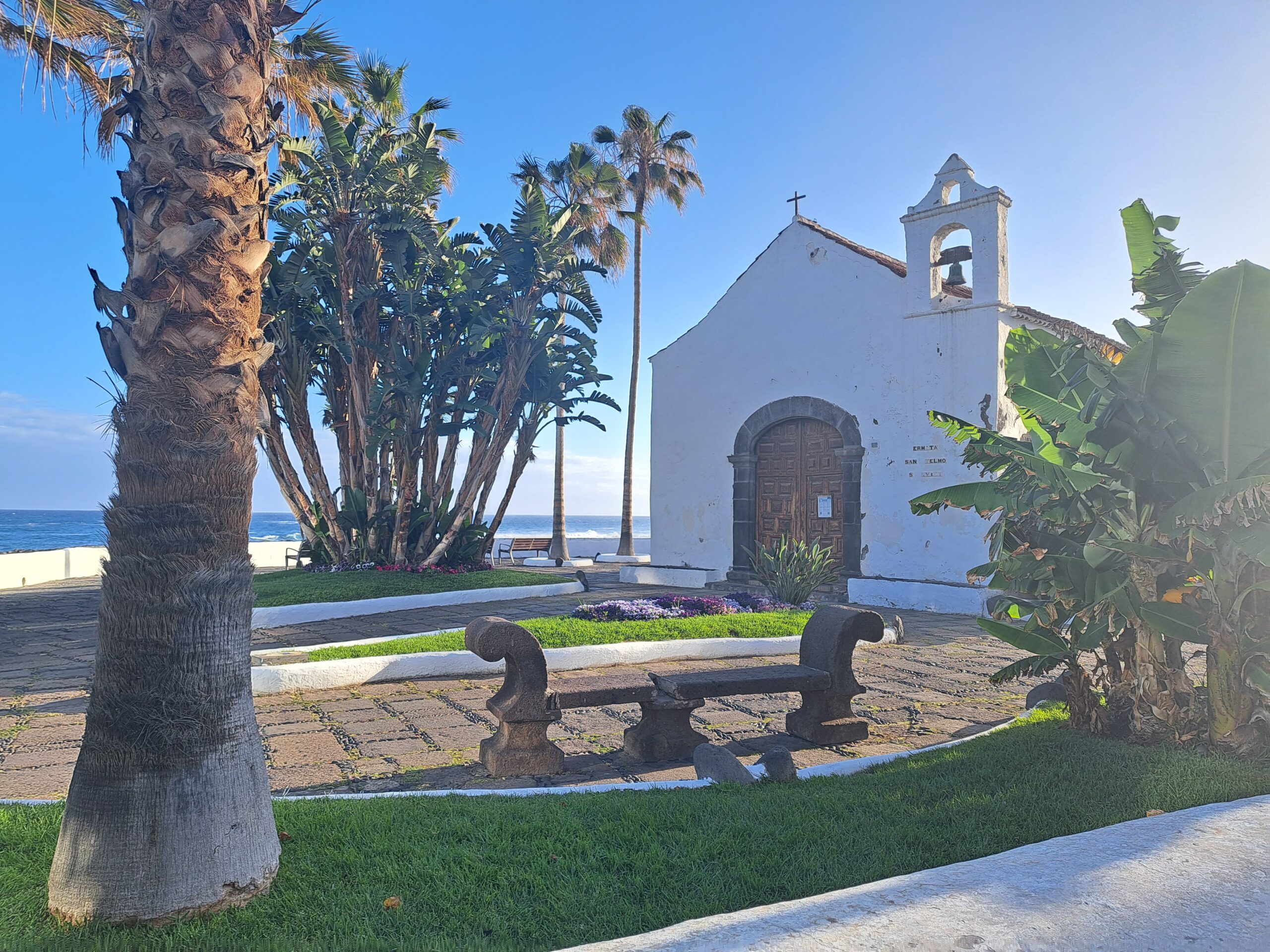
At the eastern end of Paseo de San Telmo, a small white chapel stands just above the Atlantic. People pass it on their way to the rock pools, pause for a sea view or step inside when the doors are open. The Ermita de San Telmo is easy to admire in a few minutes, but its story reaches back through the sailors of Puerto de la Cruz, a nearby Dominican convent, a coastal battery and the town’s July celebrations. Take a little longer here and the chapel becomes a window onto the old port.
Ermita de San Telmo at a glance
Where: beside the sea at the eastern end of Paseo de San Telmo, close to Plaza de los Reyes Católicos. Why visit: a small historic chapel linked to Puerto’s seafarers, with basalt stone doorways, a timber roof and a colourful eighteenth-century altarpiece. Outside: the remains of a coastal battery lie by the chapel precinct. Visiting: the exterior can be enjoyed from the promenade; interior access depends on worship and the chapel’s current arrangements. Check locally before making a special trip, and respect any barriers and services.
A small chapel with a big seafront setting
Approach from the town centre and the chapel appears where the promenade meets the open water. Its white walls and little bell gable are familiar landmarks above the dark volcanic rocks. Below are Playa de San Telmo and the pools that draw people to the shore; above is a place to stop, watch the waves and look along the coast. Even on a busy day, the chapel gives this stretch of promenade a sense of place.
The setting explains why sailors would have wanted a chapel here. Before the town was a holiday destination, the Atlantic was its route to work, trade and other islands. The sea could provide a livelihood and pose a danger. Devotion to San Pedro González Telmo, known locally as San Telmo and revered by seafarers, belonged to that daily maritime world. A walk here lets you see the chapel and the water it faces in one glance.
For a longer look at this part of town, our San Telmo to El Muelle video walk begins nearby and continues west along the seafront. Our beaches guide covers the rock pools and other shores separately.
The sailors who made San Telmo their own
The chapel’s history is closely bound to the gremio de mareantes, the guild of seafarers. A modern study of archival documents records that a group of 38 mariners appointed a representative in 1647 to seek permission to build a chapel at their own expense. Permission followed that December. They wanted a place of worship that belonged to their own confraternity, within reach of the people whose lives centred on the harbour and coastal waters.
This matters because the site is often described simply as a chapel founded around 1780. The seafarers’ devotion and the separate chapel have a documented seventeenth-century history. Later eighteenth-century work and renewed support for the shrine helped shape the familiar building, but 1780 should not be taken as the beginning of worship on this spot.
The historical record also names more than one place associated with San Telmo: a space in the Dominican complex, the separate chapel by the sea and a chapel with an altarpiece in the parish church. Their stories are easy to blend together. Here on the promenade, imagine the seafarers organising, collecting donations and caring for a place that spoke directly to their work and hopes.
The chapel and the Dominican convent
A Dominican convent stood a short distance away and had its own connection with the devotion to San Telmo. A severe fire in 1778 devastated the convent complex. Accounts of the fire sometimes make it sound as if the present chapel was simply the convent church rebuilt in a new position. Archival research identifies the sailors’ freestanding chapel as a separate place of worship.
That distinction makes the story richer. Friars, parishioners and the seafarers’ brotherhood all formed part of the town’s religious life, with ties and occasional disagreements over their different spaces. The little chapel on the shore was not an isolated monument; it stood in a community negotiating how to worship and care for a saint especially dear to its mariners. The image of San Telmo associated with the chapel was donated by Jerónimo Luis Román in 1783, according to the official heritage inventory.
A chapel beside a coastal battery
Look around the chapel precinct and you will see another part of its story. The official heritage description records surviving elements of the former Batería de San Telmo beside the square: a sentry point, sections of low defensive wall and palisade, and a small vaulted powder magazine above a sea-carved cave. Some remains are subtle, and their condition and access can change. Stay on permitted paths and leave the edges and enclosed spaces alone.
This was a remarkable neighbour for a place of worship. The battery watched over a small anchorage on a coast that needed defence. The shared site brought practical tensions: nineteenth-century accounts describe disputes between the sailors and military authorities over use of the ground around the chapel. From the promenade, you can take in the reason for both structures. The same rocks and water made this a fitting place for sailors to pray and a strategic place to keep watch.
A powerful storm in 1826 damaged the wall and palisade around the precinct and affected the guild’s resources. It is another reminder that the ocean here was never just scenery. The chapel has remained a point of continuity through changes to the waterfront and the town beyond it.
What to notice outside and inside
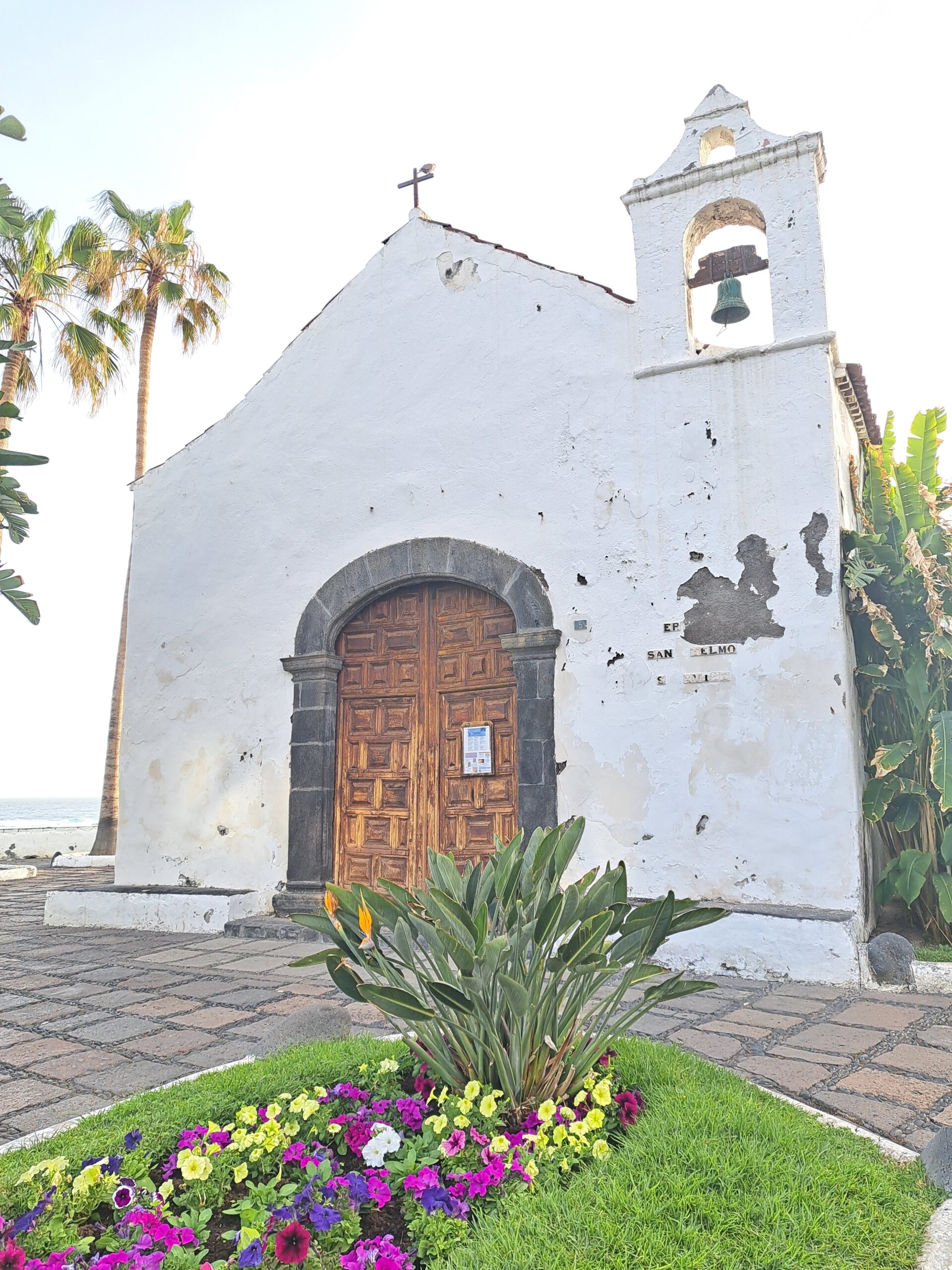
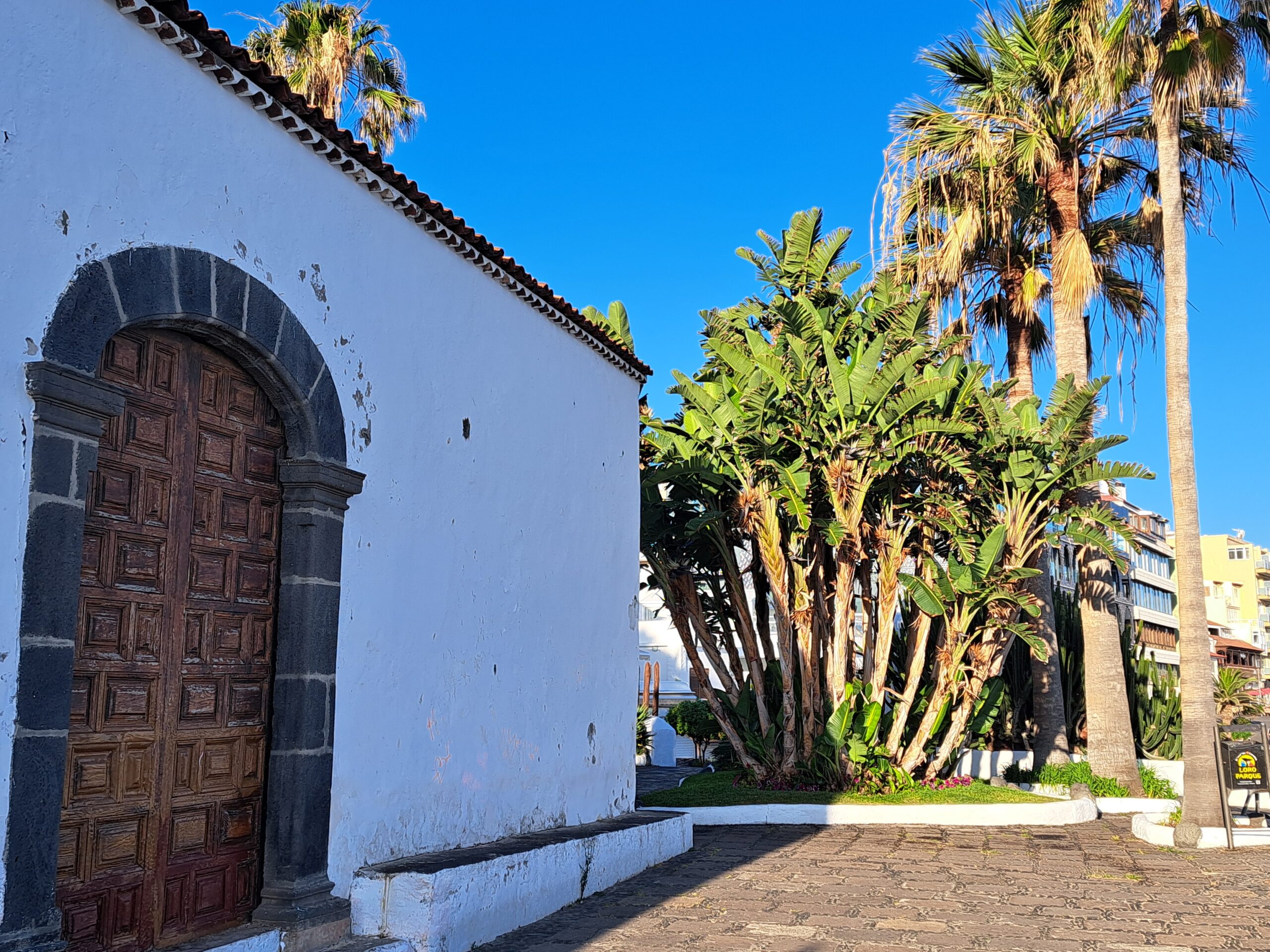
The chapel is deliberately modest. Its rectangular plan and pitched roof of traditional tiles give it a simple outline. Whitewashed walls are interrupted by two arched doorways framed in dark basalt stone. On the west-facing front, the small bell gable rises in two stages and ends in a pointed top, while a cross finishes the roofline. Walk around the public side of the building and see how the stone details stand out against the pale walls.
If the chapel is open, look up at the timber roof. The official heritage description identifies a Mudéjar-rooted structure with carved geometric decoration on its tie beams. Near the altar, painted leafy motifs and cartouches spread over the wall and into the roof area. These details give warmth and colour to a space whose outside seems so restrained.
The eighteenth-century polychrome wooden altarpiece has gold motifs against a red background. Its niche holds the image of San Telmo, donated in 1783. The heritage inventory also lists a wooden Virgen de Candelaria and San Blas, both twentieth-century works by Ezequiel de León. The interior is small enough to take in as a whole; give your eyes time to adjust, and view the images and painted surfaces from the areas open to visitors.
San Telmo in the town’s living traditions
The sailors’ devotion still has a place in Puerto de la Cruz’s July fiestas. San Telmo is honoured alongside the Virgen del Carmen in celebrations tied to the maritime identity of the town. The precise procession routes and dates vary, so consult the current programme if you plan a visit around the festivities. On an ordinary day, the chapel is quieter, though its position on one of the town’s busiest walks keeps it part of everyday Puerto.
The building was declared a Bien de Interés Cultural, in the category of Monument, in 2000. That protection covers the little chapel and its setting. It also helps explain why the remains of the battery and the space around them belong to the story of this place. The chapel’s significance lies in both the craft you can see and the generations of people who have cared about it.
Make San Telmo part of a coastal walk
A visit fits naturally into a stroll through central Puerto de la Cruz. Start by the chapel, take in its outline and the sea below, then follow Paseo de San Telmo west toward the old town. Continue past the viewpoint and Plaza de Europa, or use our filmed seafront route to find your way towards the harbour. From the eastern side, our longer Puerto de la Cruz video walk approaches San Telmo from Playa Martiánez.
If the doors are open, enter quietly and allow a little time for the roof and altarpiece. Access may change around services, ceremonies or conservation work. A closed chapel is still worth seeing from the promenade, and its history makes the view across the rocks more meaningful. Wear shoes with grip if you head down toward the shore; the rocks and pools are a separate coastal environment, and conditions there depend on the sea.
Follow PuertoDeLaCruz.info in Google
If our Puerto de la Cruz guides are useful to you, you can add PuertoDeLaCruz.info as one of your preferred sources in Google.