
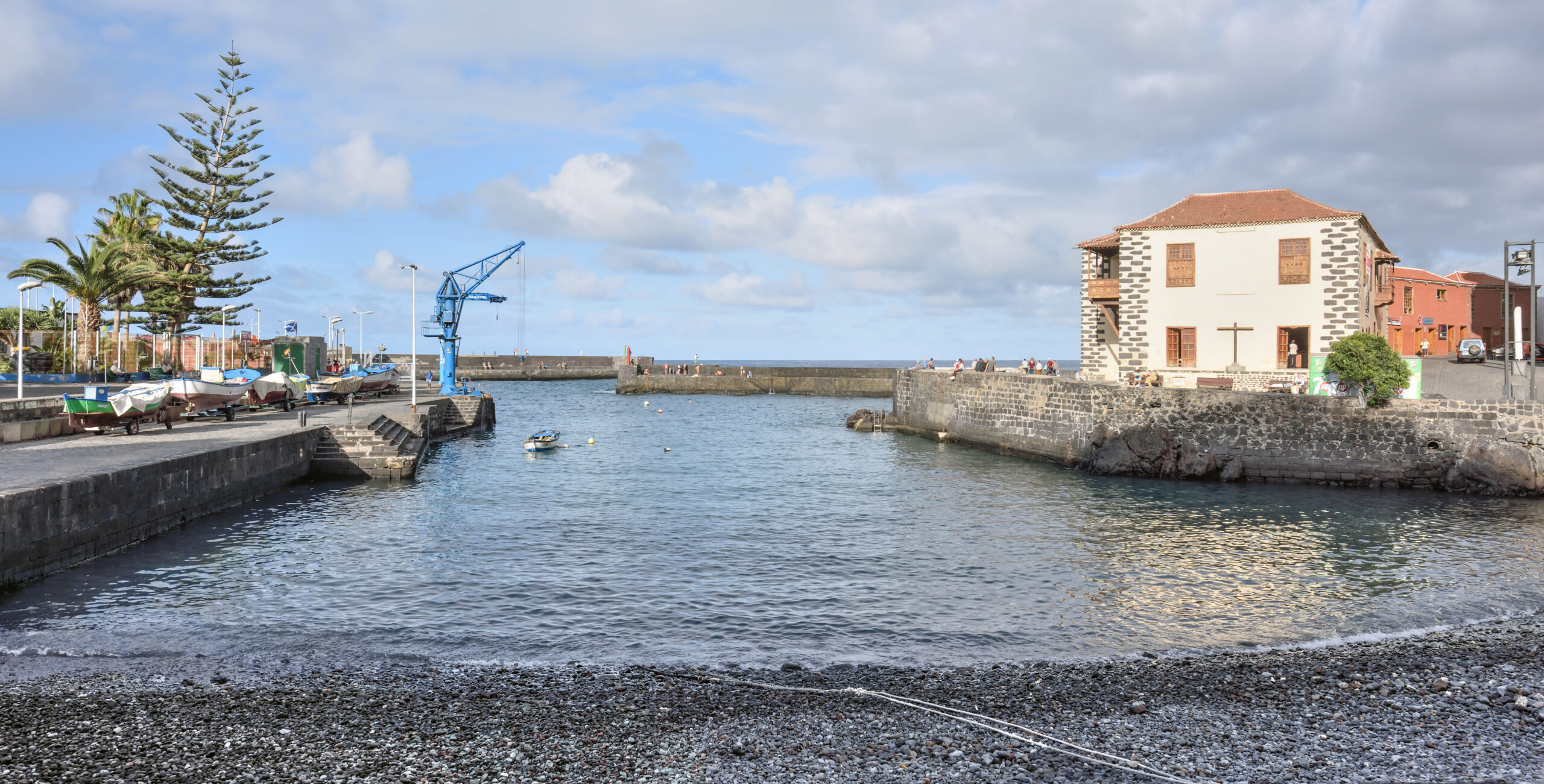
At El Penitente, beside Puerto de la Cruz’s harbour, banana crates once moved from a packing house towards ships bound for Britain. The building has gone, but the waterfront still tells the story of Yeoward Brothers: a Liverpool shipping firm, the people who grew and packed the fruit, and the pier that connected the Orotava Valley to the sea. Here is what happened here and how to find the place today.
Yeoward and El Penitente at a glance
The company: Yeoward Brothers began in Liverpool in 1894 and built a trade in Canary Islands fruit. The Puerto connection: its banana-packing premises stood beside El Penitente, on land now partly occupied by the Town Hall. The pier: Yeoward built a landing stage here for the trade in the first half of the twentieth century. See it today: explore the waterfront around the Ayuntamiento and Plaza de Europa.
Stand at the harbour and look back
The waterfront beside Puerto de la Cruz’s Town Hall is an easy place to pass without realising how much has changed. The Plaza de Europa opens to the sea; the old harbour draws you towards fishing boats and the dark volcanic shore. A century ago, this was also a working edge of the banana trade. Here, at El Penitente, Yeoward Brothers had packing premises and a landing place linked to ships carrying fruit to Britain.
The packing building is gone, so the pleasure of visiting is in reading the layers of the place. The seafront still makes sense of the old journey: fruit came down from the Orotava Valley, was prepared near the water and left by boat for the waiting steamers. The busy square and civic buildings now occupy part of that former commercial ground.
From Liverpool to the Orotava Valley
Brothers Richard Joseph and Lewis Herbert Yeoward founded their firm in Liverpool in 1894. Britain’s appetite for fresh Canary fruit gave the business room to grow. Yeoward Brothers first relied on other shipping companies, then acquired its own steamship, the Avocet, in 1900. The company’s vessels connected Liverpool with Portugal, Madeira and the Canaries, carrying passengers and goods as well as bananas and tomatoes.
The Puerto de la Cruz operation was rooted in local relationships. A heritage record places the company’s offices in a González de Chaves family house near the harbour and describes its collaboration with Hijos de Juan Yanes. The bananas themselves were grown and handled through the work of growers, farm workers, carriers and packing teams. The Yeoward name stood on the shipping line and the packing house, but the trade depended on all of them.
A study of British-owned property recorded 11 Yeoward banana estates across the Orotava Valley in 1937, covering about 70 hectares. It also documents water sources, packing stores and trucks. These are figures for the valley, not for Puerto de la Cruz alone; they show how much work and infrastructure sat behind the small harbour scene.
For the wider story of how the crop changed the landscape, see our history of bananas in Tenerife and Puerto de la Cruz.
Packing at El Penitente
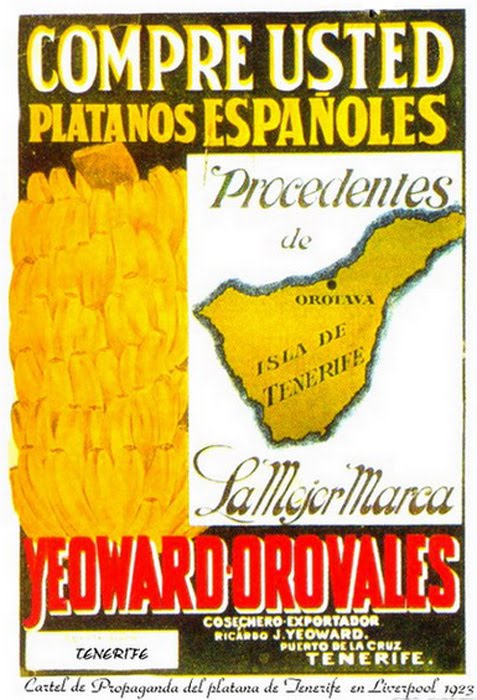
Bananas had to reach the ship in good condition. The harvest travelled from the plantations to a packing point, where it could be prepared for the voyage. Yeoward’s premises stood at El Penitente, beside the old harbour. Local heritage photographs identify the packing house there in 1965; they are a valuable record of a building that no longer stands.
Yeoward also built the El Penitente landing stage. The Town Hall’s history places that construction in the first half of the twentieth century, and a maritime history dates the completed facility to August 1929. A local heritage account describes a weekly ship taking bananas and tomatoes to the United Kingdom and bringing supplies and some visitors in the other direction. In an older image of the trade, banana crates are piled in a small craft heading out from Puerto towards a Yeoward ship offshore. It is an unusually clear reminder that the waterfront was a working transfer point, not just a view of the Atlantic.
We cannot identify an individual warehouse or a surviving length of pier from a casual look at today’s seafront. The historical location, however, is well documented: it is the area between the Town Hall, Plaza de Europa and El Penitente by the harbour.
The same ships brought visitors
The ships did not simply sail away with fruit. They also advertised journeys to the islands. A Yeoward Line poster held by Tenerife’s Museum of History and Anthropology promoted holiday travel on the Ardeola II while referring to the line’s carriage of passengers, post and bananas. The museum’s record captures the two sides of the business neatly: an island export route became a way for travellers to arrive.
Puerto de la Cruz was already developing as a place to stay, with landmarks such as the Gran Hotel Taoro. The shipping connection belongs in both histories, although a Yeoward passenger voyage and the growth of local hotels are distinct stories. The harbour linked the agricultural valley to Britain and helped bring people back across the same sea.
Before the packing house: the Dominican convent
El Penitente had a story long before the fruit boats. According to the municipality, the Dominican convent of Santo Domingo once occupied a large stretch of land between the streets and the sea. Fire devastated it in 1778. The Town Hall later used surviving parts of the convent, and its newer wing followed a 1973 redevelopment on ground formerly occupied by Yeoward’s export business.
The municipality says the name El Penitente probably relates to the friars, while treating that origin as a likelihood rather than a certainty. The nearby Plaza de Europa opened in 1992. In a few steps, you can move through traces of convent, export trade and modern civic life.
What happened to Yeoward’s Puerto operation?
The twentieth century changed both the routes for fruit and the way Puerto de la Cruz used its seafront. A local heritage catalogue says Yeoward’s last company ship, the Alca, was lost in 1955. It then used vessels operated by Aznar Line for about another decade; the El Penitente packing premises closed in the mid-1960s. That is a more careful end point than suggesting all activity stopped with the loss of the ship.
At much the same time, tourism was taking more land and space in the town. Bananas continued to be grown in the valley, but the harbour-side packing building disappeared. The company’s footprint remains easiest to understand through the municipal history, old photographs and the shape of the waterfront rather than through a standing Yeoward warehouse.
A short walk to put the story in place
Begin at the Ayuntamiento and Plaza de Europa. Look at the older convent fabric and the newer Town Hall wing, then walk towards the sea at El Penitente. From there, continue around the harbour on the San Telmo to El Muelle walk. The modern harbour view lets you imagine the short but essential final stage between the packing house and a fruit ship offshore.
To follow the crop further inland, our banana history traces the plantations, water and export trade. The walk towards El Bollullo passes surviving banana-growing land. These are separate stops, but together they show why a company based in Liverpool left such a visible mark on this corner of Puerto de la Cruz.

Follow PuertoDeLaCruz.info in Google
If our Puerto de la Cruz guides are useful to you, you can add PuertoDeLaCruz.info as one of your preferred sources in Google.