

The Town Hall facing Plaza de Europa brings several chapters of Puerto de la Cruz together. The site began as a Dominican convent in the seventeenth century, was largely destroyed by fire in 1778, and now combines surviving older fabric with a municipal building shaped by the 1973 works. Our original 4K film takes a closer look at the Ayuntamiento and the seafront setting.
What are you looking at beside Plaza de Europa?
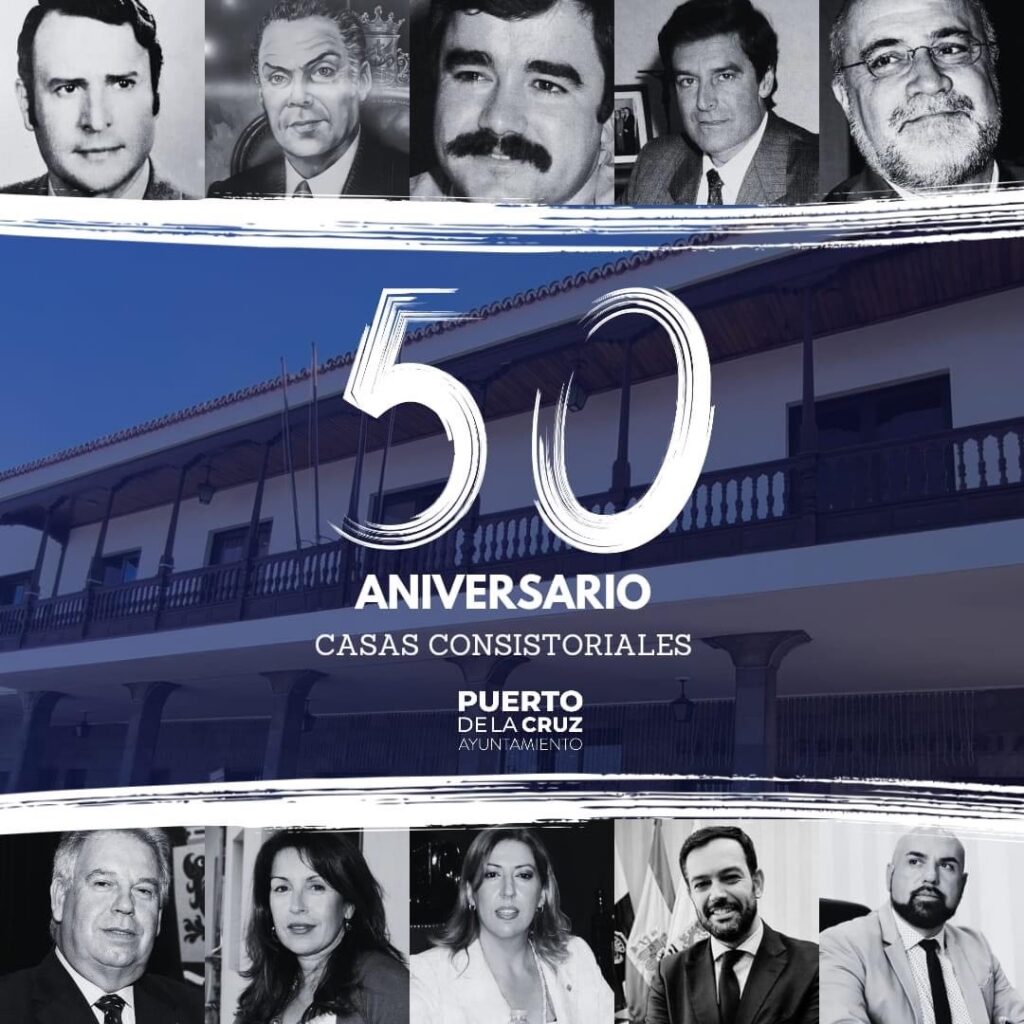
From Calle Santo Domingo and the seafront square, you are looking at a Town Hall complex with more than one building phase. The municipality distinguishes the older convent remains, where part of the former bell tower can still be discerned, from a newer section made in the 1973 redevelopment. Look for that contrast as you watch our original film of the building and Plaza de Europa.
The square in front has its own, later history. Plaza de Europa opened in 1992. For the square, its cannons and the Santa Bárbara battery by the harbour, see our separate Plaza de Europa guide.

A Dominican convent by the trading port
The Dominican community from San Benito in La Orotava founded a convent here when the Puerto de la Orotava was growing as a trading port, notably through wine exports to northern Europe. Work began in 1608 with a chapel dedicated to San Pedro Telmo, a patron of seafarers. The complex developed over decades, with a hospice, refectory and church, and was substantially completed around 1659.
The municipal history says its property once stretched from Calle Quintana towards the sea and from Punta del Viento towards the fishing harbour. That gives a sense of the former convent's scale: it was more than the visible walls of today's civic complex. Further chapels and endowments followed as the institution grew.
The 1778 fire and what survived
A fire in December 1778 almost destroyed the convent and its church. The municipality records that the image of the Virgin of the Rosary was saved and later placed in the church of Nuestra Señora de la Peña de Francia. The San Telmo image was lost; mariners subsequently raised the nearby Ermita de San Telmo in the saint's honour.
Reconstruction took place between 1781 and 1786 under architect Bethencourt y Castro, reusing parts of the earlier complex. Funding was limited, so this was not a complete restoration of the original convent. When you see an old-looking part of the Town Hall today, it is best understood as surviving or reused fabric within a building that has changed repeatedly.
From convent property to civic use
The site took on other roles in the nineteenth century. Its rooms served at times as a primary school and as meeting space for the constitutional Town Hall. Following the 1837 desamortización, the property passed into state hands and was later sold in part to private owners.
The municipality also connects the site with Luis Rodríguez Figueroa, a republican politician born here in the later nineteenth century. It records that he was murdered at the beginning of the Spanish Civil War. His family's association is another reason to treat the building as a place with a long, layered civic history rather than a single period monument.
The 1973 Town Hall and the later square
The present complex has an old section and a newer one. The municipal account describes a 1973 redevelopment on land previously occupied by the Yeoward export business, with the Rahn and Yeoward families involved in the property's more recent history. This is the twentieth-century Town Hall chapter, separate from the seventeenth-century foundation and eighteenth-century rebuilding.
The next major change to the setting came in 1992, when Plaza de Europa opened where a municipal market and battery had stood. The result is an unusually compact view of religious, trading, defensive and municipal histories around a single square. The battery and modern terrace deserve their own stop after you have seen the Town Hall.
Seeing the Ayuntamiento on a walk
Find the building on Calle Santo Domingo, facing Plaza de Europa near Punta del Viento and the old harbour. The exterior and square are easy to include on a central seafront walk; look from different sides to compare the older and newer parts. Council offices are working premises, so do not assume the historic rooms are open for sightseeing. Check with the municipality if you need a particular civic service or event.
Continue along the waterfront with our San Telmo to El Muelle filmed walk, or explore more local history.
Explore the square and old harbour
Follow PuertoDeLaCruz.info in Google
If our Puerto de la Cruz guides are useful to you, you can add PuertoDeLaCruz.info as one of your preferred sources in Google.